
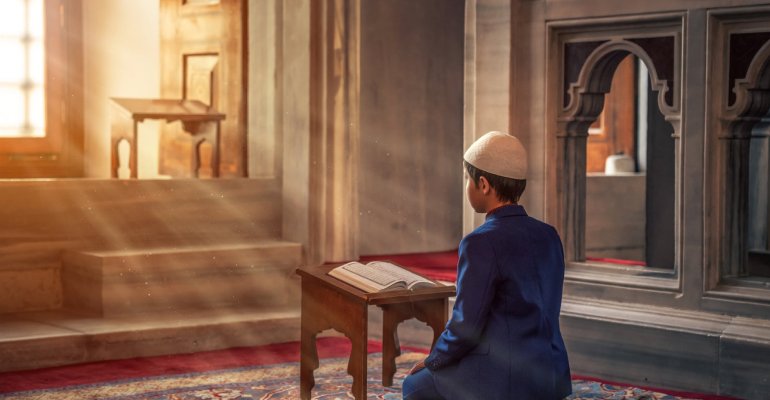

Islamic studies for children is one of the most important pillars in building the personality of a Muslim child, as it contributes to instilling good values and morals, and introducing him to his true religion in a simplified and loving way to his heart. One of the most important themes of these studies is the Sunnah of the Prophet Muhammad (peace and blessings of Allaah be upon him), which represents the practical model for applying the teachings of Islam in everyday life.
The importance of teaching Islamic studies to children
Teaching a child the principles of religion from an early age helps him to:
The formation of a strong Islamic identity.
Distinguish between right and wrong.
Build a morally and behaviorally balanced personality.
Develop a spirit of love, tolerance and respect for others.
Accustom him to worship in a gradual and easy way.
A child who is brought up on the teachings of Islam is more aware, closer to commitment, more able to positively relate to society.
What is the meaning of the Sunnah of the Prophet (peace and blessings of Allaah be upon him)
The Sunnah of the Prophet (peace and blessings of Allaah be upon him) is all that is reported about him from:
Sayings
Actions
Report
It is the second source of Islamic legislation after the Holy Quran, and it is a practical interpretation of what is stated in the book of Allah, and shows how we apply Islam in our daily lives.
The importance of teaching the Sunnah of the prophet to children
Teaching children the Sunnah of the Prophet (peace and blessings of Allaah be upon him) helps them to:
The Prophet (peace and blessings of Allaah be upon him) loved and imitated him.
Learn good manners such as honesty, honesty, compassion, humility, and charity.
Knowledge of the etiquette of eating, drinking, sleeping, talking and dealing with others.
Apply the correct Islamic behaviors in their daily lives.
Simplified methods of teaching the year to children
In order for the information to reach the child easily, it is preferable to use such interesting educational methods as:
Prophetic Stories: Narrating situations from the life of the Prophet (peace and blessings of Allaah be upon him) in an interesting way.
Interactive activities: educational games, coloring, cards.
Acting and role-playing: to embody everyday situations.
Videos and animations: to attract attention and consolidate information.
Motivational competitions: to develop the spirit of positive competition.
Models from the year of the Prophet (peace and blessings of Allaah be upon him) fit for children
Smiling at others.
Say: in the name of Allah before eating.
Thank God after the meal.
Peace when entering and exiting.
Cleanliness and purity.
Compassion for the animal.
Respect for the big and kindness for the little.
The role of family and educational institutions
The family plays a pivotal role in instilling the teachings of Islam and the Sunnah of the Prophet (peace and blessings of Allaah be upon him) in the souls of children, and this role complements educational institutions such as schools, Islamic centers and electronic educational platforms, by providing simplified, interactive, and age-appropriate content.
Conclusion
Teaching Islamic studies to children and the Sunnah of the Prophet (peace and blessings of Allaah be upon him) is a real investment in building a righteous, conscious, and religion-loving generation capable of contributing positively to its society. Every value that we instill today in the hearts of our children, tomorrow will bear fruit a high-class morality and behavior that will build a strong, cohesive nation.
Leave A Comment